Monday, July 5, 2010

Atalantic Ocean to the Pyrenees

St-Jean-de-Luz and Ciboure, France serve as tourist havens today, but were once thriving fishing communities. Fifty years ago, this Basque coast region supported over 1,000 fishermen and 22 fish processing factories. Today, less than 100 fishermen exist, and the last fish processing facility was closed 10 years ago. Overfishing by multi-national businesses and environmental pollution are reasons Michel Pery and his father Jean (first photo) given for the loss of their local fishing industry. Discouraged by his father to enter into the fishing profession, Michel enjoys what he calls a very primate art. After 40 years of experience, he fishes now only for personal reasons. Twelve types of fish are found locally and 20 kilos of bonite (photo) was his catch for the day. After chilling overnight, he salts and packs the bonite into tins with olive oil. After 2 years of curing in the tin, this beauty is ready to eat. He sent me and my crew home with about 3 kilos of bonite which we prepared that evening. Cut into 2 inch slabs, battered in flour, salt, and pepper, and fried, our catch of the day turned out to be an exquisite culinary feast. It was slightly sweet, light, and melted on the tongue. We gourmand on our gourmet fish!

Additional photos include: Ciboure cooperative fish market, beach near my cabin, Pyrenees mountain scenes, and Tour de France sculpture


Tuesday, June 29, 2010

Fromage de bredbis fermier


At the age of 35, Maxium Boucaud decided to change his profession in the field of dentistry to sheep farming. Later, he discovered that his grandfather was a brebis fermier, a sheep breeder.
Home for his 42 sheep, Le Tuc, which means the top in the local dialect, is situated 70 kilometers north of Toulouse in Vazerac. I met Maxium at the farmers' market in Toulouse and he brought me to his farm for the weekend to observe his operation. He produces two types of sheep cheese, a tome de brebis and lactiquer, and at times, ricotta and yogurt. The tome de brebis is a 3 month aged cheese, whereas the lactiquer is ready in one week. At this time, his sheep are milked morning and evening and yield about 40 liters of milk. Processed daily at varying temperatures and humidity, Maxium has an adroit feel for when the cheese is ready to move to the next process and has a special eye for the right amount of salt. Maxium's friend Jerome impressed me how quickly he worked the 42 sheep through the milking process. Milking begins in mid-February and will go into September. Maxium allows his sheep to mature to two years of age before milking, where commercial breeders begin at less than a year old. Not only is Maxium's cheese heavenly but so is his cooking (picture). He prepared a locally grown chicken, with handmade pasta from the market. Much of his produce, breads, meats, and pasta comes from trading with other vendors at the organic market in Toulouse.
I was lucky to arrive on the weekend that the neighboring farmers had a festival celebrating the summer solstice. Under a full moon, a traditional fire was lit and local foods, wines, and music was served to all as the beautiful spirit of community flooded the vast countryside.


Add Image


Monday, June 28, 2010

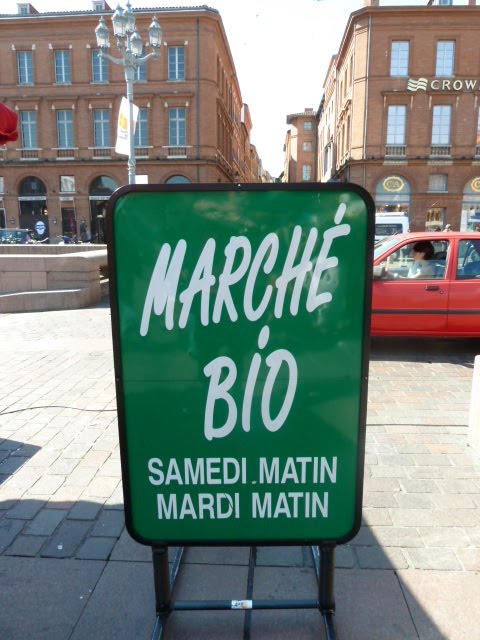
Place de Capitole Organic Food Market


Toulouse offers an organic farmers' market every Saturday and Tuesday morning at Place de Capitole. The 25 plus organically certified vendors offers seasonal fruits and vegetables, herbs, cheeses, eggs, meats, eggs, honey, bread, handmade pastas, plants, and condiments, such as the tasty sea salt harvest in Guerande. My next blog spot will be about a sheep breeder and cheese maker I met at this market, Maxium Boucaud, (pictured with cheese) of Le Tuc Farm who invited me to his farm.


Sunday, June 27, 2010

AMAP Les Pavillons - French style CSA

Welcome to AMAP Les Pavillons Friday evening food distribution in Toulouse! For what I could interpret, this mimics our Community Supported Agriculture system. AMAP Les Pavillons has 25 member who pay 20 euro per week for a basket of organic food. This week had fresh goat cheese, bread (baked on-site), peas, squash, lettuce, potatoes, beets, and raspberries. Their farmer grows on 5 hectares of land, and distributes about 150 food baskets weekly to several locations. This three-year old membership conducted a meeting prior to the food distribution to increase membership to help support their farmer.


Friday, June 25, 2010

Slow Food France


Many thanks to the staff at Slow Food France! Slow Food is an international movement founded by Carlo Petrini in 1986. It strives to preserve traditional and regional cuisine and promotes farming of plant, seeds and livestock characteristics of the local ecosystem. Slow Food has expanded globally to over 100,000 members in 132 countries. Check out their website at: www.slowfood.com

Pictured: Lucia Lora Aprile (in red shirt), Latger Anne (dark blue), Elisa Villella (green), and Lucia Penazzi (light blue)

Lucia Lora connected me with breeders of Pyrenees goats, noir de Bigorre pigs, and Mirandais beef. These rare specialized breeds are located in the Midi-Pyrenees region. My bike is headed in that direction! I am looking forward in sampling their products and will need the extra protein from pedaling uphill!